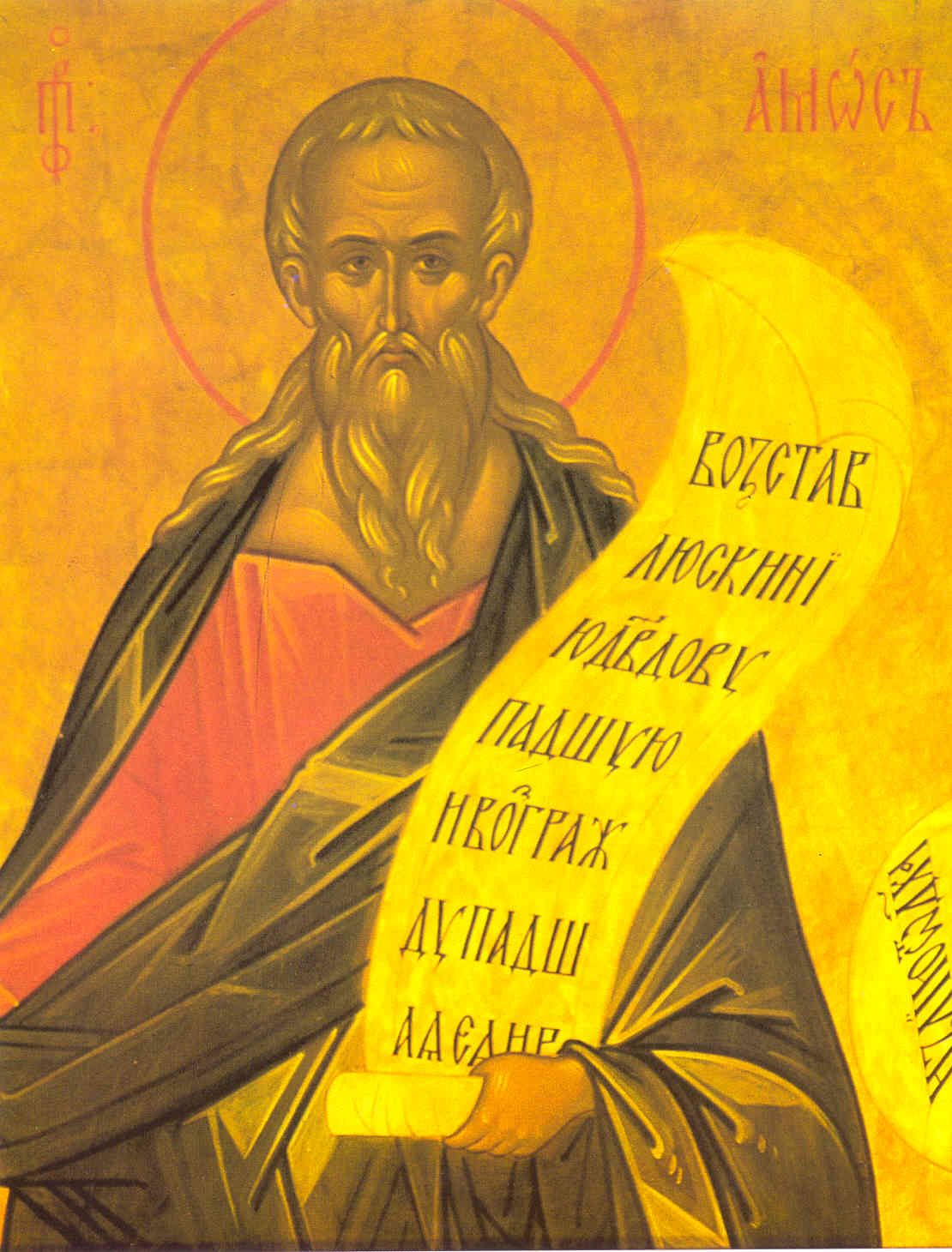
The real heart of Amos’ prophecies was his message to the people of the northern kingdom of Israel (sometimes also called Ephraim, after its dominant tribe). So, when we get to verse 6 of chapter 2, we come to the heart of Amos’ message. Everything has been a preparation for this.
You can find my comments on the earlier portions of this prophecy here:
The other nations have been condemned only to underline the message of judgement against Israel. The dramatic, repeated formula appears again:
כֹּה אָמַ֣ר יְהוָ֔ה עַל־שְׁלֹשָׁה֙ פִּשְׁעֵ֣י יִשְׂרָאֵ֔ל וְעַל־אַרְבָּעָ֖ה לֹ֣א אֲשִׁיבֶ֑נּוּ
“Thus says the LORD: For three transgressions of Israel, and for four, I will not turn back….”
What had they done?
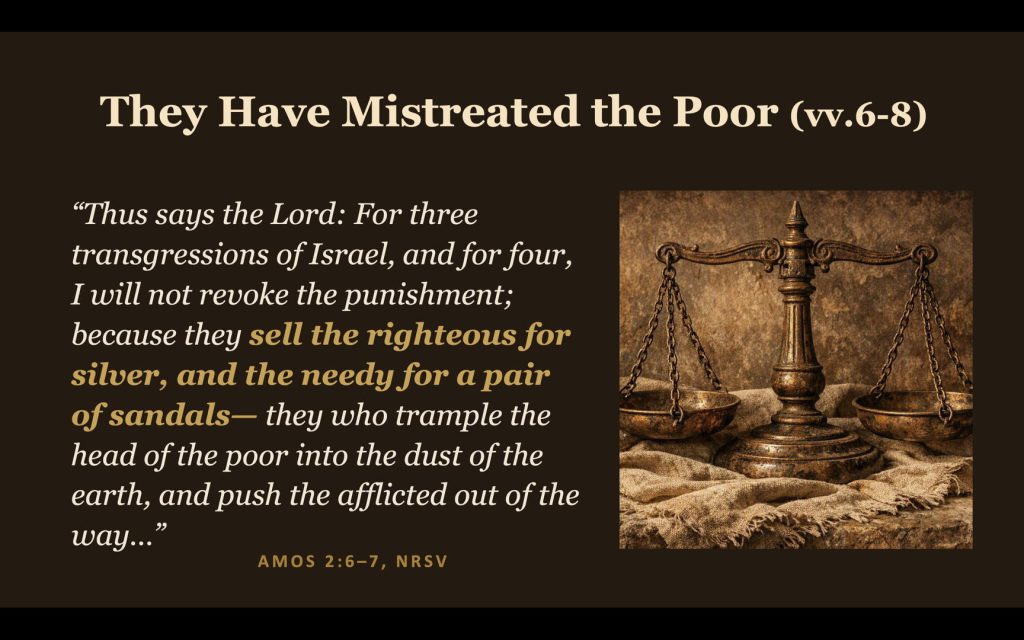
(1.) They have mistreated the poor (vv.6-8): “…because they sell the righteous for silver, and the needy for a pair of sandals — they who trample the head of the poor into the dust of the earth, and push the afflicted out of the way….”
It seems to me that the following phrases are intended to speak of the same sorts of crimes: “father and son go in to the same girl, so that my holy name is profaned; they lay themselves down beside every altar on garments taken in pledge; and in the house of their God they drink wine bought with fines they imposed.” I’m taking “father and son go in to the same girl” to mean that father and son (in a household) are sexually abusing the same servant girl. My reason for taking it that way is the context: the crimes listed are crimes of the rich taking advantage of the poor. So, also, their crimes against the poor are illustrated by “garments taken in pledge” and “wine bought with fines they imposed.”
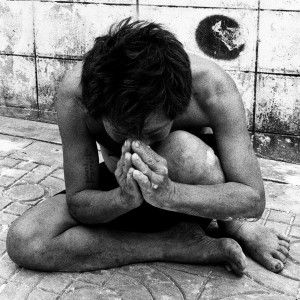
The clear message of the Bible is that nations are judged by their treatment of the poor. Why have Christians so often lost sight of this?
I suppose Amos, if he lived today and were speaking to us would be accused of “class warfare.” But, it is a repeated theme in the message of the prophets: the measure of a society is how it treats its weakest, most vulnerable members. There is a very real sense in which God has a bias toward the poor — just as God has a bias toward the needy and the helpless and the outcast.
We need to consider this when we think about our values and our economics. The prophets of the Old Testament are clear — and we should heed it — the nations will be judged by how they treat the poor and the vulnerable.
Our politics and our views on economics need to be informed by the prophets. We need to hear what they say about fairness and justice, about inequality and equity. We cannot allow politics — and the prevailing political options of the day — to blind us to the values toward which the Bible points us. It’s not about politics in the usual partisan sense — it is about recognizing God’s values. It’s not a partisan issue, folks. It’s just a Christian issue. “If you close your ear to the cry of the poor, you will cry out and not be heard.” (Proverbs 21:13 NRSV).
(2.) They silenced the voice of the godly (vv. 11, 12): “But you made the nazirites drink wine, and commanded the prophets, saying, ‘You shall not prophesy.’”
They did not worship God and they would not hear the voice of God’s servants. They sought to corrupt them. They sought to silence them. And why would that be? The voice of God’s people is an independent voice — not beholden to the powers that be. The prophets speak from a higher authority. Their voices challenge the culture and they challenge the powerful. Every Nazarite who takes and keeps his vows (see Number 6:1-21) speaks to the world about a higher reality. He says there is a reason to forgo some of the pleasures of life: there is a higher purpose to life. There is a God. That’s why the Nazarites’ vow was so intolerable. It points to God.

The people had shamed and silenced those that God had raised up. “And I raised up some of your children to be prophets and some of your youths to be nazirites. Is it not indeed so, O people of Israel? says the LORD.” (v. 11). And, why was all of this so especially bad? Because they had been favored by God (vv.9, 10).
Here Amos refers to the events recorded in the books of Moses: the deliverance from Egypt, the wanderings through the wilderness and the establishment of the nation in the land where Amorites had formerly lived. As I said before, Amos is a radical traditionalist: he takes the shared history of the people and applies it to his own day.
This assumes that the people already know this story. When were the first copies of the material in Genesis, Exodus, Leviticus, Numbers and Deuteronomy written down? We will probably never know conclusively. It is natural to suppose that some editing of these writings occurred during the exile of Judah and then, during it’s first establishment back in Palestine. But, the stories certainly pre-date Amos (thought to be the first of the writing prophets). He assumes the people are quite familiar with the story.

They are a people favored by God. But, they have become greedy and materialistic. They have silenced the voices of the prophets. And, Amos’ message to them is this: You want to see judgement come to the nations for their sins? Then, be prepared for judgement on yourselves!
“So, I will press you down in your place, just as a cart presses down when it is full of sheaves. Flight shall perish from the swift, and the strong shall not retain their strength, nor shall the mighty save their lives; those who handle the bow shall not stand, and those who are swift of foot shall not save themselves, nor shall those who ride horses save their lives; and those who are stout of heart among the mighty shall flee away naked in that day, says the LORD.” (Amos 2:13-16 NRSV).
It was a difficult message to hear. Everything must have seemed fine. The wealthy were prosperous, and seemingly secure. But, the moral foundations of the nation had corroded — under the influence of materialism and greed. Amos doesn’t need to name an enemy nation. One will come. The kingdom’s fall is just a matter of time.
It is also a message to all of those who have been favored by God but forget the poor.
For monthly supporters on Ko-fi: there are sermon presentation files for a message on this passage (number #5 in the series on the prophet Amos) in the shop for free download. They are in PPTX and ODP formats. They contain speaker’s notes, transitions and animations. You are free to edit, or modify these as you wish. Or: you can just use them as a sermon starter. You may download them here: Danger in the Good Times.
Some of these may have text too small for congregations to read, so be careful about that. (Sometimes I let some of Microsoft’s design suggestions through.) I put another image below, so you can see what I’m talking about.