
How did the clergy role manage to develop from preacher to pastor to CEO? And, is this a good thing?

The early Methodists, clearly saw the preaching role as of foremost importance. John Wesley was a preacher. Yes, he was certainly an organizer as well, but preaching was foremost. He traveled on horseback all over England preaching — often several times a day. Charles Wesley was a preacher. Adam Clarke was a preacher — his commentary on the entire Bible was a side project. All his learning was in the service of preaching.
Yes, the early Methodists believed in the value of “visiting house to house” but it’s clear from the way they talk about it, that they meant teaching from house to house — including the instruction of children. It was an extension of the preaching role.

The early Methodist preachers in this country were evangelists, who rarely stayed in one place for long. The leadership and (what we think of as) pastoral roles had to be fulfilled by lay leaders and class leaders and others in the local church. The task of preaching was too important — the circuit riding preacher needed to be on the move, spreading the Word to new people.
Older churches in the revivalistic model had Sunday morning services, Sunday evening services and midweek prayer services. Then there were revival meetings — often twice a year — and camp meeting in the summer.
But, somewhere along the line, clergy developed from being primarily preachers to being primarily pastors. The emphasis shifted from spreading the Word to tending the flock. Someone more knowledgeable than I might be able to say when this shift began and why.

But, here the focus shifts. It’s not about winning new people, or deepening the commitment and knowledge of the church people — it is taking care of the people you have. The emphasis now turns to meeting the needs of people — the church that does it the best has the best ministry. Attention turns inward.
It’s not that preachers can’t be pastors or pastors can’t be preachers — the issue is which role is uppermost. Which is most important? I remember an otherwise a very fine United Methodist bishop exhorting the clergy at Annual Confereence that people would forgive them their poor sermons if they truly demonstrated that they loved them. (And in my cynicism I mentally replied: “Well, you’ve never been to my house. I guess I can forgive you nothing.”) In this paradigm preaching is not important — the clergy person needs to be an excellent care-giver — and this is what will strengthen the church.

But, then the focus shifted again as people said that clergy needed to be primarily leaders. Now the insights began to come from the business world. Preacher / Pastors, now needed to be trained in organizational management. This, it was claimed, was the great deficiency in Seminary training — no classes in leadership!
Now the uppermost image was the Chief Executive Officer. The clergy person was a leader, teaching others to lead. The clergy had been reading the wrong books. The books that would be most helpful to them would be the same books that were most helpful in the business world.
And the expectations are now piled up on each other — preacher, pastor, CEO. I have read some people who say that this is the most challenging era in which to serve in the ordained ministry — the expectations are too high, and too complex. How likely is it that one person will be gifted and effective in all these areas? And, which is most important?
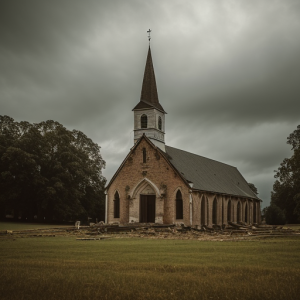
Maybe now that so many churches are declining and dying — and so few young people are (quite understandably) going into ordained ministry — it is time to take a new look at this. Has the church been killing itself? Yes. Of course, it has — there is simply no one else to blame.
Maybe a newer, more missional, paradigm will arise — maybe it already has. I’d like tho think so. And as the old sinks under the weight of its growing expectations and plummeting effectiveness — maybe some people will remember again how important it is to tell the story of Jesus in compelling and life changing ways. Maybe they will find the ways to do it. Maybe something good will arise out of the rubble of the failing church.