I have previously written about spirituality in what might be called a generic sense: as a human capability. A simple way of understanding the spiritual side of human nature is to see it as the capacity for self-transcendence.
I have explored this idea here:
As I say, it is possible to see all of this as “spirituality” in a generic sense. It’s a human capacity.
To go further in discussing this, I need to draw on ideas explicitly from Christian theology. At this point, the Christian perspective gives us some help in understanding how human spiritual capabilities connect us with God and with the world around us.
The helpful concept in this case is the Holy Spirit. Our human capacity — and yearning — to reach out beyond ourselves is answered by the reality of God’s Spirit reaching to us. This is only natural to expect. We have a desire to connect with a higher reality than ourselves. Our desire to breathe is answered by the air around us. Our desire for food and water are answered the reality of food and water. Our desire for a connection with God — which would give a framework of meaning to our lives and our moral choices — is answered by the Holy Spirit of God.
It is sometimes said that the doctrine of the Spirit is a neglected theme in Christian theology. Maybe in some circles this is true. It has not been true in either the Holiness or Pentecostal streams of the Christian tradition. The emphasis in these movements has been on Christian experience and the practical aspects of the life of faith, great emphasis has, in fact fallen on the work of the Spirit.
1. The Holy Spirit is the Spirit of Life.

It is helpful, in the first place, to remember who the Spirit is and the nature of the Spirit’s role in general. “In the beginning God created the heavens and the earth. The earth was formless and void, and darkness was over the surface of the deep, and the Spirit of God was moving over the surface of the waters.” (Genesis 1:1,2 NASB).
The Spirit of God is spoken of in the Bible as being the Spirit of all life. “O LORD, how many are Your works! In wisdom You have made them all; The earth is full of Your possessions. There is the sea, great and broad, In which are swarms without number, Animals both small and great. … They all wait for You To give them their food in due season. You give to them, they gather it up; You open Your hand, they are satisfied with good. You hide Your face, they are dismayed; You take away their spirit, they expire And return to their dust. You send forth Your Spirit, they are created; And You renew the face of the ground.” (Psalm 104:24-30 NRSV.)
God has created by His Spirit. God upholds all life by His Spirit. When we speak of the Holy Spirit we are speaking of the very breath of God that breathed life into the human race at the beginning. “…then the LORD God formed man from the dust of the ground, and breathed into his nostrils the breath of life; and the man became a living being.” (Genesis 2:7 NRSV).
Because God is the Creator and preserver of all life, the Spirit of God is also the Spirit of all life. This larger Biblical view of the work and role of the Holy Spirit — which comes out most expressly in the Old Testament — must be kept in mind as think about this.

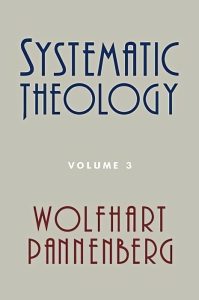
In the beginning of an essay entitled “The Spirit of Life,” Wolfhart Pannenberg writes:
When the second Ecumenical Council of the Church at Constantinople (381) made additions to the Nicene Creed, the Father’s first reinforcement of the third article was a qualification of the Holy Spirit as the one who gives life. This term was, of course, far from novel; it recalled the New Testament descriptions of the Spirit. Paul and John in particular had spoken of the Spirit as the one who makes alive, or quickens; as the primal source of life. Nowadays that is often interpreted restrictively as a purely soteriological expression referring to the new life in faith — a topic which is undeniably at the centre of the early Christian writings. But, references to the Spirit as the giver of life are certainly not to be restricted to the life of faith.
— Wolfhart Pannenberg, “The Spirit of Life” Faith and Reality (translated by john Maxwell) 1977.
Creation itself is spoken of in the Bible as beginning with the movement of the Spirit upon the primal waters: “…while a wind (spirit ר֣וּחַ) from God swept over the face of the waters.” (Genesis 1:2 NRSV). The talents of prophets and craftsmen and poets and artists and heroes are spoken of as being inspired by the Spirit of God. While, the New Testament is primarily concerned to speak of the new life or the eternal life (ζωὴν αἰώνιον) that is available through faith in Christ — but this promise is given against the backdrop of this larger vision of the Spirit as the Spirit of all life.
Although the New Testament writings when they speak of the Spirit are primarily concerned, therefore, with his charismatic presence and the new life of faith mediated by him, the profound scope of these statements and their peculiar logic are only apparent if one is aware that they are rooted in basic convictions of Jewish tradition about the Spirit as the creative origin of all life.
— Wolfhart Pannenberg, “The Spirit of Life” Faith and Reality (translated by john Maxwell) 1977.
The God that Christians worship is no parochial God — but the God of all people. So, also the work of the Spirit must first of all be understood to be universal in scope.
2. This Connects with the Wesleyan Theological Concept of Prevenient Grace.
This line of thought naturally brings us into the realm of what theologians in the Wesleyan tradition call Prevenient Grace. By this we mean to speak of the grace of God that is available to all people — whether they are aware of it or not. This is the grace that stirs in the heart of all people, calling them to search for meaning, and purpose — as well as forgiveness and reconciliation. It is a grace that convicts and convinces the world. It is “the life” that is “the light of all people.”

Grace is available — in this form — to all because God is the God of all people and because the Spirit of God is the Spirit of all life. Remembering the Old Testament depiction of the Spirit as the source of all life — and the source of all inspiration — leads us in this direction.
Both Charles Gutenson in Reconsidering the Doctrine of God and Kent Eilers in Faithful to Save: Pannenberg on God’s Reconciling Action note the similarities of Wolfhart Pannenberg’s doctrine of the work of the Holy Spirit and John Wesley’s conception of Prevenient Grace.
The Spirit of God has an epistemic role — making the knowledge of God a possibility. It is precisely this prevenient grace that makes it possible for human beings to even know God.
Our very capacity for self-transcendence is a gift from God. It opens for us a possibility that our lives need not be consumed by selfishness and self-destruction. Grace is conveyed to us in our lost-ness — making saving faith in Christ a possiblity.
3. The Spirit Connects Us with All of Life.
In fact, it is the work of the Spirit of God to connect us with God, with other people, and with life in the world.
Self-transcendence need not lead to escapism — though obviously it can, and often does. The Spirit of God, being the Spirit of life and the Spirit of God, seeks to lift us out of ourselves into connection with the God of all creation, and the best interests of other people — and, ultimately, all creation.
As long as our lives are closed in upon ourselves, in fact, there is no hope for this. The hope given to us in the Gospel of Christ includes the possibility of being lifted beyond ourselves — in love for God (who has created all) and in love for all other people. And, that is certainly good news.