There are times when God seems absent. It seems that direction and blessing are gone. We have no sense that our prayers are being heard. We may be in a time of stress and trial, where there seems to be no relief in sight. Service that formerly brought us joy becomes dry and unrewarding. And we ask: Why?
Christian readers need to continually remind themselves: the Old Testament believers had no developed doctrine of the afterlife. In much of Christianity the idea of the afterlife — of rewards and punishments in the world to come — dominates the thinking of believers. In Christianity, this has become such a commonplace idea we must consciously remind ourselves that it is missing (for the most part) from the thinking of the Old Testament writers.
It’s not just Christians who may be surprised — or even shocked — by the absence of this theme. There are some observers who have theorized that religion exists as a way of addressing the fear of death. If that were the case, it would be impossible to account for the Jewish religion in Old Testament times (or: the religion of the ancient Greeks at the time of Homer, either. Just read The Iliad sometime.).
Because the believers of Old Testament times had no developed doctrine of the afterlife, they tended to see the issues of right & wrong / rewards & punishments as playing themselves out in this life. For example, you can see this clearly in the book of Proverbs: do right and things will go well for you, do wrong and you will suffer.
Forgiveness — the pardon of sins — is a central issue in Christianity. Jesus has made it so — and has taught us to pray: “forgive us our sins as we forgive those who sin against us.”
Yet, it is also such a difficult issue. When there is a deep wound, the pain is still there, and the anger still arises. In times like this, we wonder: do the words mean anything? When time and time again, you have to pray “Lord, give me the grace to forgive my enemy” you have to wonder if there is ever hope for you. There have been many times, when I have wondered this about myself. And, I know I’m not alone in having this problem.
Those people who have done things that have caused wounds — especially those who have done it quite deliberately and knowingly — are hard to forgive. Many people have been treated unfairly and unjustly. People have been abused. And, the problem with forgiveness is that it seems to say that all that was okay. To let go of the anger and the outrage seems to give in to injustice — to give permission for the abusers to do it again.
When I was just starting out in Christian pastoral ministry (long ago) I was drawn to the writings of Paul for preaching material. It read more like theology to me — it seemed more about ideas and morality — and seemed a better fit for the needs of a three-point sermon outline. I could simply draw from Paul’s writings my point #1, point #2 and so forth. All my points were Biblical (from my perspective at the time) since they each had a verse or a phrase from one of Paul’s letters attached to them.
What I was missing was that all these assertions Paul makes, all the apparently abstract theology and moralizing, was, in truth, reflection on the life, death and resurrection of Jesus — working out its implications for first century believers. The Epistles must take us back to the Gospels — or else, we are just not getting it. The Gospel message we need to communicate is the story of Jesus.
Some people think that if they can just find God’s perfect will then their life would be easier — problems, setbacks, and disappointments would be eliminated. Really? I don’t know where such ideas come from — but a moment of thought will dispel them.
The great Bible characters did not have lives that were devoid of difficulties or setbacks or griefs or disappointments. If this did not happen with them, how can we reasonably expect it for ourselves? Jesus grieved over Jerusalem. The apostle Paul knew setbacks and discouragements in his ministry. How can I suppose my life can be free from such things?
The path of the Lord is not easy, it is worthwhile. Those who choose to live as Christ has taught make a positive contribution to life — to their own life and to the lives of others. We move along a difficult path characterized by faith and love and hope. And, by doing so, we bring more faith and hope and love into the world.
How would we want other people to think of you? Wouldn’t you want them to think the best? For some people it becomes an obsession: wondering what other people think of them. It is a source of anxiety and shame. Most of the time the truth of the matter is: they don’t spend much time thinking about us at all. And, how much does it matter anyway? Should it?
How do we want God to think of us? That can be a disturbing line of thought. Many people I know were raised in a hellfire and brimstone religion, where the angry judgement of God was a prominent theme. Human sinfulness & depravity was held up as the basic fact of human nature. We are sinners. And, God is holy. God is offended and angry over our sin. God must condemn us. It is only right.
This message, resonates with something deep inside us. We know we are not the people we should be. We are often ashamed of ourselves. And, we can’t help but reason: God must know of flaws and errors that we don’t. We are quick to condemn ourselves. Why wouldn’t God condemn us? In fact, it is hard for us to imagine that God would think more highly of us than we think of ourselves. Isn’t it?
That is why the message of God’s love is always so hard to believe. If we are sometimes tempted to worry about what other people think of us — how much more worrisome the thought of what God might think of us.
There are times when we may feel we’ve lost our way. The future seems uncertain and the direction we need to take unclear.
But, there are also times when we feel confident that we know the way — that we know the will of God — at least reasonably well. Psalm 25:4,5 suggests that we really don’t know the way unless we seek to know it. It further suggests that the process of seeking God’s will may take me some time and effort.
I have been discussing this Psalm as a Psalm for the “Waiting Times” of our lives (here and here and here). Verses 4 and 5 show us the positive value of these times of waiting: it’s a time to seek God’s will and direction.
I have commented here and here about the themes I see in Psalm 25, but I haven’t said a word so far about the structure of the Psalm. This hardly seems right. It is a bit like putting the cart before the horse. But, I wanted to give you an idea why I find this Psalm so interesting.
The structure is interesting too. This is one of those alphabetic psalms. The first verse begins with the first letter of the Hebrew alphabet, the next verse with the next letter, and so forth. (Other alphabetic psalms are 9, 10, 34, 37, 111, 112, 119 and 145.) The last verse of Psalm 25 is outside this structure.
I want to make some additional introductory remarks about Psalm 25. I said last time that Psalm 25 is a psalm for the Waiting Time. I haven’t always seen it that way. I first became aware of the prominence of this “waiting” theme in this psalm through Peter Craigie’s commentary. Even without Craigie’s conjectural reading, the theme of “waiting” is still found in the repeated use of the Hebrew term קָוָה (qāwāh, v. to hope in; to hope for, wait for, look for) in verses 3 and 21.
“May integrity and uprightness preserve me, for I wait for you.”
I think it’s worthwhile to take a moment to notice the close relationship between the concepts of “waiting” and “hoping.” This relationship is (I think) not immediately apparent to the modern reader.
On the basis of [the] function of Jesus’ message [as the criterion of God’s judgment] and the New Testament emphasis on the all-encompassing love of God (e.g., Matt. 8:11; John 10:16), Pannenberg asserts that correspondence with the will of God as reflected in Jesus’ proclamation — that is, the command to seek first God’s kingdom and the double command to love — rather than an actual encounter with the Christian message, is the basis of final judgment (Matt. 25:41ff.).
The step in this direction is prepared by a thesis, developed in the Christology and ecclesiology sections, that love for others entails participation in God’s love for the world. This understanding of the criterion for judgment means that persons who live in accordance with Jesus’ message will be included in the divine salvation, whereas nominal Christians may find themselves excluded. To the resultant question, If an encounter with Jesus is not the sole condition for salvation, what is the Christian’s advantage? he replies that Christians have the advantage in that they know what the standard of judgment is. Although he emphasizes the universality of the possibility of salvation in this manner and even moves the concept of eternal condemnation to that of a border situation, Pannenberg is unwilling to embrace universalism.
This resonates very well with the sense I remember getting from my initial reading of Volume 3 of Pannenberg’s Systematic Theology.
There is so much here to like. This fits very well with the Wesleyan themes that: (1.) “without holiness no one will see the Lord” and that, in turn, (2.) the essence of this holiness is love to God and love for other people. It sets this theology apart from the common variety of evangelicalism which posits salvation either by creed or by a particular religious experience. Faith in Christ is the doorway into holy living. A faith that makes no difference in a person’s life is a dead faith — or, as Wesley would point out the faith of the devil and the demons! This is not saving faith. Faith brings a person’s life into ever-growing continuity with the will of God revealed in Christ.
The proclamation of Jesus was
“The time is fulfilled, and the kingdom of God has come near; repent, and believe in the good news.” (Mark 1:15 NRSV).
This also was the proclamation entrusted to Jesus’ disciples. It is a message which is moral to the core — it calls for a change in attitude and a change in life. It calls us to align ourselves with God’s purposes — for our lives and for our world. We turn. We leave the past behind. We begin anew. We seek God’s will and God’s Reign — however imperfectly we may understand, and however imperfectly we may see it realized. It is a call to change our ways.
We do not have the right to turn it into something else. How can it become merely “change your worldview” or “put a check-mark in this box” — when the call is to repent, and to believe and become a part of the redemptive work of God in the world?
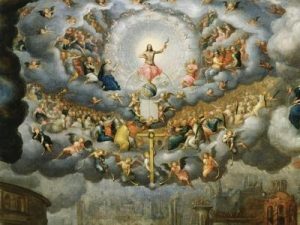
Nevertheless, this understanding of the Last Judgment also calls us to look beyond the church itself — to God’s will and purpose for all the human race. Thus, it resonates well with the New Testament’s inclusive vision.
“For [God] will repay according to each one’s deeds: to those who by patiently doing good seek for glory and honor and immortality, he will give eternal life; while for those who are self-seeking and who obey not the truth but wickedness, there will be wrath and fury. There will be anguish and distress for everyone who does evil, the Jew first and also the Greek, but glory and honor and peace for everyone who does good, the Jew first and also the Greek. For God shows no partiality. All who have sinned apart from the law will also perish apart from the law, and all who have sinned under the law will be judged by the law. For it is not the hearers of the law who are righteous in God’s sight, but the doers of the law who will be justified. When Gentiles, who do not possess the law, do instinctively what the law requires, these, though not having the law, are a law to themselves. They show that what the law requires is written on their hearts, to which their own conscience also bears witness; and their conflicting thoughts will accuse or perhaps excuse them on the day when, according to my gospel, God, through Jesus Christ, will judge the secret thoughts of all.” (Romans 2:6-16 NRSV)
The God proclaimed by Jesus is not a parochial God whose concern is only for a small club or group. God’s purposes have to do with all humanity — and God’s Spirit has been sent upon all flesh. We know there is salvation and new life in the name of Jesus. All who know Christ then proclaim this — and what faith in Christ’s name will mean in the conduct of their lives. But, God’s purposes are greater than we know. And, God’s purposes in Christ are expansive. “… in Christ God was reconciling the world to himself….” (2 Corinthians 5:19 NRSV). “Then Peter began to speak to them: ‘I truly understand that God shows no partiality, but in every nation anyone who fears him and does what is right is acceptable to him.’” (Acts 10:34, 35 NRSV.)
The benefit of the death of Christ is not only extended to such as have the distinct knowledge of his death and sufferings, but even unto those who are inevitably excluded from this knowledge. Even these may be partakers of the benefit of his death, though ignorant of the history, if they suffer his grace to take place in their hearts, so as of wicked men to become holy.
— John Wesley, “A Letter to a Person Lately Joined with the People Called Quakers”
So, this is another reason I like the way this is formulated: it expresses an appropriate hope for all people. This is what I keep calling “Hopeful Inclusivism.” It is not necessarily a doctrine of universal salvation, but it is a hopeful doctrine of universal grace.
And, it reminds us that that religion per se is not that hope. All people are called to hear and heed the message of Christ — and that includes religious people. The name of Christ is no shield from repentance and faith. The name of Christ does not relax the urgency of God’s call to new life, to discipleship and service. Christ is our way into the life God calls us to live. I don’t think there is anything so obnoxious to God as false, unrepentant, religion.
And, yet, while affirming a universalistic hope, this did not push Pannenberg to complete universalism. It is true that in Christ there is hope for all. It is true that in Christ we know that God is loving and just — and thus, will deal with all people with justice and fairness. But Pannenberg still leaves room for the possibility of eternal damnation as, as Grenz says, “a border situation.”
In fact that’s one of the things that surprised me when I first read the last part of Pannenberg’s Systematic Theology. As I read along I thought sure we were about to arrive at universalism — maybe on the next page. But, no! Surely, we can hope for the salvation of all. We would wish for it. But, Pannenberg still felt that there are some who will resist God and God’s will and purpose — however expansively defined — even to the very end.
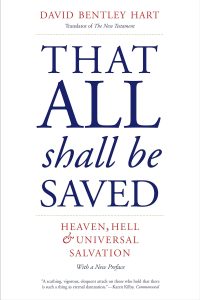
Certainly David Bentley Hart has made a strong case — formally irrefutable, really — for an ultimate universalism in his book That All Shall Be Saved (2019). I’m not sure what Pannenberg would have said to that. II feel no one should resist the idea. Ultimate salvation is a hope consistent with the character of the God we know through Jesus Christ. Yet, there is much about eternity, the nature of the human consciousness and will, etc. that we do not understand. We do not dare undermine the warnings of proximate moral judgement in the light of ultimate salvation, anyway. The reality of Judgement is clear.
So, as I say, there is much to like (at least from from my admittedly idiosyncratic point of view) in this perspective on the Last Judgement. But, I do have some disagreements, as well. This (again, quoting from Grenz) seems terribly inadequate to me:
To the resultant question, If an encounter with Jesus is not the sole condition for salvation, what is the Christian’s advantage? he replies that Christians have the advantage in that they know what the standard of judgement is.
There is salvation and life in the name of Christ. There is the growing experiential knowledge of God’s will — discovered through Scripture and prayer and service and worship and interaction with others. Through faith in Christ these things become Means of Grace to lift us higher into the life of faith. Through them The Holy Spirit works in our inner lives to bring us into conformity to Christ.
But, God’s will for the human race is that we come to reflect God’s character. “You shall be holy, for I am holy.” And, this is what God is seeking from beginning to end.