Psalm 135 is essentially a Psalm of praise. We are called into praise from the very opening “Hallelujah” (praise Yah).
It is a song of worship and it calls us into an attitude of worship. As Adam Clarke says: “It is an exhortation addressed to the priests and Levites, and to all Israel, to publish the praises of the Lord.”
The opening verses are an exhortation to worship. Verses 3-5, and 6, 7 extol God’s greatness. Verses 8-12 remind the people of Israel of God’s saving acts in their history: their deliverance from Egypt and the defeat of legendary kings. Then, they are called again to praise.
Remembrance has a significance for our faith. It is good to recount for ourselves the answered prayers we have experienced — and the unexpected blessing of God on our lives. The Bible is a book of remembrance: recounting the deeds of the Lord God in times past, as a way of illuminating our lives in the present. We know God through what God has done. For Christians, it is the story of Jesus — before any other — that calls forth our praise. And, so it is that in this psalm, the remembrance of God’s deliverance in the past, calls forth praise.
This is one of several items I re-blog every once in a while. And, here’s why. It illustrates one of the huge gulfs between contemporary Methodism and the original Methodism that arose under the leadership of John Wesley. Methodism originally combined: serious Biblical study, impassioned preaching, a personal experience of faith, a serious discipline for spiritual formation and the service of God in the world.
This is from a letter by Adam Clarke to a young man contemplating the ministry. Readers will find this advice a bit (ehem!) challenging. Actually, I think it is good advice myself, though I’d (of course) update the reference works, and have to acknowledge I’m quite a bit more “rusty” on biblical languages (and thus much more reliant on secondary sources) than I wish I were.
First (after the divider rule) I quote Adam Clarke at length. Then (after the next divider) I give some reflection on why I think these remarks are important. (I’ve done some re-formatting. I found this letter in a brief biography of Adam Clarke’s life which had been written by his son-in-law, Samuel Dunn and included in a compendium of Clarke’s writings called Christian Theology.)
“I would lay down two maxims for your conduct:
Never forget any thing you have learned, especially in language, science, history, chronology, antiquities, and theology.
Improve in every thing you have learned, and acquire what you never had, especially whatever may be useful to you in the work of the ministry.
“As to your making or composing sermons, I have no good opinion of it.
“Get a thorough knowledge of your subject: understand your text in all its connection and bearings, and then go into the pulpit depending on the Spirit of God to give you power to explain and illustrate to the people those general and particular views which you have already taken of your subject, and which you conscientiously believe to be correct and according to the word of God. But get nothing by heart to speak there, else even your memory will contribute to keep you in perpetual bondage. No man was ever a successful preacher who did not discuss his subject from his own judgment and experience. The reciters of sermons may be popular; but God scarcely ever employs them to convert sinners, or build up saints in their most holy faith. I do not recommend in this case a blind reliance upon God; taking a text which you do not know how to handle, and depending upon God to give you something to say. He will not be thus employed. Go into the pulpit with your understanding full of light, and your heart full of God; and his Spirit will help you, and then you will find a wonderful assemblage of ideas coming in to your assistance; and you will feel the benefit of the doctrine of association, of which the reciters and memory men can make no use. The finest, the best, and the most impressive thoughts are obtained in the pulpit when the preacher enters it with the preparation mentioned above.
“As to Hebrew, I advise you to learn it with the points. Dr. C. Bayley’s Hebrew Grammar is one of the best; as it has several analyzed portions of the Hebrew text in it, which are a great help to learners. And Parkhurst’s Hebrew Lexicon exceeds all that ever went before it. It gives the ideal meaning of the roots without which who can understand the Hebrew language? Get your verbs and nouns so well fixed in your memory that you shall be able to tell the conjugation, mood, tense, person, and number of every word; and thus you will feel that you tread on sure ground as you proceed. Genesis is the simplest book to begin with; and although the Psalms are highly poetic, and it is not well for a man to begin to acquire a knowledge of any language by beginning with the highest poetic production in it; yet the short hemstitch form of the verses, and the powerful experimental religion which the Psalms inculcate, render them comparatively easy to him who has the life of God in his soul. BYTHNER’S Lyra-Prophetica, in which all the Psalms are analyzed, is a great help; but the roots should be sought for in Parkhurst. Mr. Bell has published a good Greek grammar in English; so have several others. The Greek, like the Hebrew, depends so much on its verbs, their formation and power, that, to make any thing successfully out, you must thoroughly acquaint yourself with them in all their conjugations, &c. It is no mean labor to acquire these; for, in the above, even one regular verb will occur upward of eight hundred different times! Mr. Dawson has published a lexicon for the Greek Testament, in which you may find any word that occurs, with the mood, tense, &c. Any of the later editions of Schrevelius will answer your end. Read carefully Prideaux’ History. The editions prior to 1725 are good for little; none since that period has been much improved, if any thing. “Acquaint yourself with British history. Read few sermons, they will do you little good; those of Mr. Wesley excepted. The Lives of holy men will be profitable to you.
“Live in the divine life; walk in the divine life, Live for the salvation of men.”
— Adam Clarke, “Clarke in the Pulpit and in Prayer.”
Before I go any further, let me add one quick note: it seems likely to me that Clarke emphasizes studies in Hebrew in this passage because it could be assumed that this young man already knew Greek and Latin — education being a bit different in those days than it is now. Nowadays, no such assumption can be made, and the study of ancient Greek should be emphasized first.
But, here’s why I think this is good advice:
(1.) Content must take precedence over form. Preaching has become empty and boring for lack of fresh content, fresh insight arising from the preacher’s immersion in the Scriptures and the life of prayer. The absolute first rule of public speaking (to my mind) is: have something to say. No amount of borrowed illustrations or quickie sermon helps will make up for this deficiency. Training in Homiletics cannot help if there is no deep insight from Scripture and prayer and life.
I agree that not everyone will be an Adam Clarke. And, his advice is quite off-putting in that way. Not all of us (certainly including myself) will achieve the command of ancient languages that Clarke achieved. No, not everyone is going to develop the passion for ancient languages that he had. On the other hand, bear in mind, that this man was one of Wesley’s local preachers! He was not a scholar working in a secluded University. He was engaged in ministry and preaching. And, look what he produced! Reading should be wide. All knowledge — granted it is legitimate knowledge — is relevant to the preacher’s task.
(2.) The absolute second rule of public speaking (to my mind) is: speak with passion and enthusiasm. You have to care. You have to think that what you have to say is important. It needs to show that you do. Preachers can only become preachers through deep, sustained Bible Study and prayer. All other knowledge they can gain is bound to be of benefit.
(3.) My third rule would be this: Live the life of faith. Then, you can talk about it. As Clarke says: ““Live in the divine life; walk in the divine life, Live for the salvation of [others].” But, you can never be a preacher by studying preaching. The preacher must preach from the overflow.
On the basis of [the] function of Jesus’ message [as the criterion of God’s judgment] and the New Testament emphasis on the all-encompassing love of God (e.g., Matt. 8:11; John 10:16), Pannenberg asserts that correspondence with the will of God as reflected in Jesus’ proclamation — that is, the command to seek first God’s kingdom and the double command to love — rather than an actual encounter with the Christian message, is the basis of final judgment (Matt. 25:41ff.).
The step in this direction is prepared by a thesis, developed in the Christology and ecclesiology sections, that love for others entails participation in God’s love for the world. This understanding of the criterion for judgment means that persons who live in accordance with Jesus’ message will be included in the divine salvation, whereas nominal Christians may find themselves excluded. To the resultant question, If an encounter with Jesus is not the sole condition for salvation, what is the Christian’s advantage? he replies that Christians have the advantage in that they know what the standard of judgment is. Although he emphasizes the universality of the possibility of salvation in this manner and even moves the concept of eternal condemnation to that of a border situation, Pannenberg is unwilling to embrace universalism.
This resonates very well with the sense I remember getting from my initial reading of Volume 3 of Pannenberg’s Systematic Theology.
There is so much here to like. This fits very well with the Wesleyan themes that: (1.) “without holiness no one will see the Lord” and that, in turn, (2.) the essence of this holiness is love to God and love for other people. It sets this theology apart from the common variety of evangelicalism which posits salvation either by creed or by a particular religious experience. Faith in Christ is the doorway into holy living. A faith that makes no difference in a person’s life is a dead faith — or, as Wesley would point out the faith of the devil and the demons! This is not saving faith. Faith brings a person’s life into ever-growing continuity with the will of God revealed in Christ.
The proclamation of Jesus was
“The time is fulfilled, and the kingdom of God has come near; repent, and believe in the good news.” (Mark 1:15 NRSV).
This also was the proclamation entrusted to Jesus’ disciples. It is a message which is moral to the core — it calls for a change in attitude and a change in life. It calls us to align ourselves with God’s purposes — for our lives and for our world. We turn. We leave the past behind. We begin anew. We seek God’s will and God’s Reign — however imperfectly we may understand, and however imperfectly we may see it realized. It is a call to change our ways.
We do not have the right to turn it into something else. How can it become merely “change your worldview” or “put a check-mark in this box” — when the call is to repent, and to believe and become a part of the redemptive work of God in the world?
Nevertheless, this understanding of the Last Judgment also calls us to look beyond the church itself — to God’s will and purpose for all the human race. Thus, it resonates well with the New Testament’s inclusive vision.
“For [God] will repay according to each one’s deeds: to those who by patiently doing good seek for glory and honor and immortality, he will give eternal life; while for those who are self-seeking and who obey not the truth but wickedness, there will be wrath and fury. There will be anguish and distress for everyone who does evil, the Jew first and also the Greek, but glory and honor and peace for everyone who does good, the Jew first and also the Greek. For God shows no partiality. All who have sinned apart from the law will also perish apart from the law, and all who have sinned under the law will be judged by the law. For it is not the hearers of the law who are righteous in God’s sight, but the doers of the law who will be justified. When Gentiles, who do not possess the law, do instinctively what the law requires, these, though not having the law, are a law to themselves. They show that what the law requires is written on their hearts, to which their own conscience also bears witness; and their conflicting thoughts will accuse or perhaps excuse them on the day when, according to my gospel, God, through Jesus Christ, will judge the secret thoughts of all.” (Romans 2:6-16 NRSV)
The God proclaimed by Jesus is not a parochial God whose concern is only for a small club or group. God’s purposes have to do with all humanity — and God’s Spirit has been sent upon all flesh. We know there is salvation and new life in the name of Jesus. All who know Christ then proclaim this — and what faith in Christ’s name will mean in the conduct of their lives. But, God’s purposes are greater than we know. And, God’s purposes in Christ are expansive. “… in Christ God was reconciling the world to himself….” (2 Corinthians 5:19 NRSV). “Then Peter began to speak to them: ‘I truly understand that God shows no partiality, but in every nation anyone who fears him and does what is right is acceptable to him.’” (Acts 10:34, 35 NRSV.)
The benefit of the death of Christ is not only extended to such as have the distinct knowledge of his death and sufferings, but even unto those who are inevitably excluded from this knowledge. Even these may be partakers of the benefit of his death, though ignorant of the history, if they suffer his grace to take place in their hearts, so as of wicked men to become holy.
— John Wesley, “A Letter to a Person Lately Joined with the People Called Quakers”
So, this is another reason I like the way this is formulated: it expresses an appropriate hope for all people. This is what I keep calling “Hopeful Inclusivism.” It is not necessarily a doctrine of universal salvation, but it is a hopeful doctrine of universal grace.
And, it reminds us that that religion per se is not that hope. All people are called to hear and heed the message of Christ — and that includes religious people. The name of Christ is no shield from repentance and faith. The name of Christ does not relax the urgency of God’s call to new life, to discipleship and service. Christ is our way into the life God calls us to live. I don’t think there is anything so obnoxious to God as false, unrepentant, religion.
And, yet, while affirming a universalistic hope, this did not push Pannenberg to complete universalism. It is true that in Christ there is hope for all. It is true that in Christ we know that God is loving and just — and thus, will deal with all people with justice and fairness. But Pannenberg still leaves room for the possibility of eternal damnation as, as Grenz says, “a border situation.”
In fact that’s one of the things that surprised me when I first read the last part of Pannenberg’s Systematic Theology. As I read along I thought sure we were about to arrive at universalism — maybe on the next page. But, no! Surely, we can hope for the salvation of all. We would wish for it. But, Pannenberg still felt that there are some who will resist God and God’s will and purpose — however expansively defined — even to the very end.
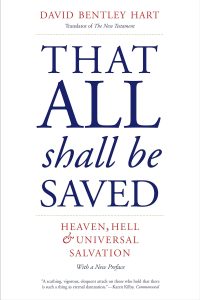
Certainly David Bentley Hart has made a strong case — formally irrefutable, really — for an ultimate universalism in his book That All Shall Be Saved (2019). I’m not sure what Pannenberg would have said to that. I feel no one should resist the idea. Ultimate salvation is a hope consistent with the character of the God we know through Jesus Christ. Yet, there is much about eternity, the nature of the human consciousness and will, etc. that we do not understand. We do not dare undermine the warnings of proximate moral judgement in the light of ultimate salvation, anyway. The reality of Judgement is clear.
So, as I say, there is much to like (at least from from my admittedly idiosyncratic point of view) in this perspective on the Last Judgement. But, I do have some disagreements, as well. This (again, quoting from Grenz) seems terribly inadequate to me:
To the resultant question, If an encounter with Jesus is not the sole condition for salvation, what is the Christian’s advantage? he replies that Christians have the advantage in that they know what the standard of judgement is.
There is salvation and life in the name of Christ. There is the growing experiential knowledge of God’s will — discovered through Scripture and prayer and service and worship and interaction with others. Through faith in Christ these things become Means of Grace to lift us higher into the life of faith. Through them The Holy Spirit works in our inner lives to bring us into conformity to Christ.
But, God’s will for the human race is that we come to reflect God’s character. “You shall be holy, for I am holy.” And, this is what God is seeking from beginning to end.
Recently I posted: John Wesley and Spiritual Gifts. There I attempted to show that while Wesley was open to both extraordinary spiritual gifts and miracles, he did not insist on them as proof of the Holy Spirit’s presence.
Now let me say something about the distinctive pentecostal and charismatic teaching about Baptism with the Holy Spirit. There is a relationship between early Methodist teachings and the later development of Pentecostal teachings. In fact, a direct line can be traced from the teaching of the early Methodists to the teaching of the early Pentecostals.
Wesley’s preaching about the Christian life — and what he called Christian Perfection — gave rise to the holiness movement. The holiness movement, in turn, provided the seedbed from which the early Pentecostal movement would arise. Once people’s thinking about Christian experience begins to go down a particular road, certain directions become inevitable.
In this passage John Calvin says that God sends people to Hell for no other reason than that God wishes to do so:
“Many professing a desire to defend the Deity from an invidious charge admit the doctrine of election, but deny that any one is reprobated…. This they do ignorantly and childishly since there could be no election without its opposite reprobation. God is said to set apart those whom he adopts for salvation. It were most absurd to say, that he admits others fortuitously, or that they by their industry acquire what election alone confers on a few. Those, therefore, whom God passes by he reprobates, and that for no other cause but because he is pleased to exclude them from the inheritance which he predestines to his children.”
You can find the definition of “reprobation” here at thefreedictionary.com: “(Theology) Christianity: condemnation to eternal punishment in hell; rejection by God.”
I find the doctrine of Calvinistic predestination — which Calvin himself says includes the idea of reprobation — i.e. that God sends people to Hell by God’s own choice and design — deeply distasteful.
John Wesley was also horrified by it:
John Wesley (1703-1791)
This is the blasphemy for which (however I love the persons who assert it) I abhor the doctrine of predestination, a doctrine, upon the supposition of which, if one could possibly suppose it for a moment, (call it election, reprobation, or what you please, for all comes to the same thing) one might say to our adversary, the devil, “Thou fool, why dost thou roar about any longer? Thy lying in wait for souls is as needless and useless as our preaching. Hearest thou not, that God hath taken thy work out of thy hands; and that he doeth it much more effectually? Thou, with all thy principalities and powers, canst only so assault that we may resist thee; but He can irresistibly destroy both body and soul in hell! Thou canst only entice; but his unchangeable decrees, to leave thousands of souls in death, compels them to continue in sin, till they drop into everlasting burnings. Thou temptest; He forceth us to be damned; for we cannot resist his will. Thou fool, why goest thou about any longer, seeking whom thou mayest devour? Hearest thou not that God is the devouring lion, the destroyer of souls, the murderer of men? Moloch caused only children to pass though the fire: and that fire was soon quenched; or, the corruptible body being consumed, its torment was at an end; but God, thou are told, by his eternal decree, fixed before they had done good or evil, causes, not only children of a span long, but the parents also, to pass through the fire of hell, the ‘fire which never shall be quenched; and the body which is cast thereinto, being now incorruptible and immortal, will be ever consuming and never consumed, but ‘the smoke of their torment,’ because it is God’s good pleasure, ‘ascendeth up for ever and ever.’ “
I occasionally get push back on this. Like this message, which I received several years ago:
Those who come will be accepted. You cite that like God will exclude any who come. Faith in the finished works of Christ (active and passive obedience) and repentance are the appointed means to salvation. faith and repentance as well as regeneration are the work of the Spirit (God) in us to point us to Christ (God-man), and it’s by grace from Abba Father (God).
I do not mean to deny salvation by grace. This person’s comment tries to put the best foot forward and ignore the chilling realities of Calvin’s doctrine. But, to “reprobate” people means that God has chosen to send them to hell “for no other cause but because he is pleased to exclude them from the inheritance which he predestines to his children.” They did not come because God had determined beforehand that they could not come.
This next correspondent was much more angry with me, he’s a little inarticulate, but he was probably so angry it was hard to type:
Sir,
God’s holiness, justice and righteousness is beyond anyone’s mind to measure, they did not come because they are determined to walk away and hate God. God left them condemned already in their own weight. Christ (the word who is God became flesh) came to the rescue of many appointed to salvation and the Holy Spirit intervenes, changed their inner being and to enable them to follow Him willingly this was to show His grace, mercy and love beyond measure, and off the chart of anyone’s capacity to comprehend.
Now, who is responsible for the damnation of the reprobates: is it God? Yes, because he is just to punish them, is God responsible for their committed crimes? no, it is not He who created sin in them, He did not. He made the decree of man’s disobedience but allowed it to happen because of man’s independent rebellion.
God is just to send all humanity to hell but by His sovereign electing grace chose a definite people for Himself and set them apart to express His mercy and love. This is the revelation of His attributes and He cannot abandon one attribute for the sake another and that’s what Christ did to satisfy justice and appeased wrath through His death on the cross and can now be still holy, just, righteous, gracious, merciful, and loving. You should have considered this.
Let me also explain this quote “God sends people to Hell for no other reason than that God wishes to do so” He has all the reason and God wishes to do so because of their sin, yet He is willing to save some for the praise of His glorious grace and that’s good news! Calvin simply wanted to refute the error of those who admit the doctrine of election, but deny that any one is reprobate which is illogical. reprobate is a ‘sinner’ who is not of the elect and is predestined to damnation and again, God did not predestined them to commit sin nor predestined anyone to commit suicide yet allowed it to happen anyway out of their own weight and predestined them into condemnation and there’s no need the power of God to make them reprobate but only out of their own weight. He is not surprised because He upholds everything from eternity past to eternal future.
Again God did not manipulate sin to enter but simply allows it to take place for a greater purpose and that includes the revelation of Himself to His creation through His redemptive acts recorded is Scripture.
Well, while I appreciate his rushing to the defense of Mr. Calvin, this is all gobbledygook to me. While this is not well written, the writer has stated the Calvinistic line pretty well (from what I know of it). But, it still doesn’t make any sense to me.
However, the “love” and “justice” of the Creator he describes is not either “love” or “justice” in any really meaningful sense. The love and justice of the Creator that he posits are contrary to love and justice as we would understand them.
Since we are spiritually shaped by the God we serve, this type of theology seems to me to be morally and spiritually toxic. It undermines the meaning of both love and justice. I know many very good Christians — and there have been many throughout Christian history — who subscribe to this type of theology but whose lives rise above it and I am thankful for that — and for them. Certainly God is faithful and sometimes overlooks our faults and misconceptions. Certainly there are many things about God that we will never understand fully because our minds are incapable of conceiving of God as God truly is. I believe all forms of determinism — this would include the Calvinistic theology to which this correspondent subscribes, but would also include naive forms of universalism, and atheistic forms of determinism — undermine the notion of moral responsibility and trivialize human action.
It does not exalt the sovereignty of God to make God a deterministic monster. I believe that the God revealed to us in Jesus Christ is a God of universal grace and love. I believe of Christ that: “in him was life, and the life was the light of all people.” (John 1:4 NRSV).
I believe that salvation is offered to all — not as a ruse, but as a reality.
John Wesley (1703-1791).
“I appeal to every impartial mind… whether the mercy of God would not be far less gloriously displayed, in saving a few by his irresistible power, and leaving all the rest without help, without hope, to perish everlastingly, than in offering salvation to every creature, actually saving all that consent thereto, and doing for the rest all that infinite wisdom, almighty power, and boundless love can do, without forcing them to be saved.”
— John Wesley, “Predestination Calmly Considered.”
P. S. Actually, there are some forms of Reformed theology to which I have little or no real substantive objection. And, while I often quote Calvin unflatteringly, he said and taught many good things — and at times, seems less strict in his “Calvinism” than many of his followers are.
First, I need to explain this: when I say “Methodist” I don’t mean it in any denominational sense at all. Yes, I served for many years as a pastor in the United Methodist Church. And, at that time I was quite loyal. I came to Christ long ago at a holiness camp-meeting. But, I really don’t mean to speak of this in any sectarian sense at all.
For many, the often over-stated claims of the Holiness movement are an embarrassment. Yet, I find these writings a helpful corrective to the casual “Christians Aren’t Perfect They’re Just Forgiven” attitude of so much of contemporary Christian culture. It’s a helpful corrective to a church that has come to peaceful terms with the injustices of this world — rather than challenging and correcting them.
I am glad I came to Christ in the context of a group of people who believed that faith in Christ made a real difference in a person’s life. I am thankful for a message — however difficult — that challenged me to fully open my life to the power of God’s Spirit. I am glad I heard a Gospel that still held to a message, not only of forgiveness, but also of change and new life. John Wesley’s writings and the commentaries of Adam Clarke were formative influences on me in the development of my faith — and my understanding of the meaning and relevance of the Bible’s teachings. Every once in a while I run across something that reminds me why I’m glad I used to read this material — and the value I have always found in it.
The Gospel as preached by Wesley and those who imitate him, appeals with peculiar force to the intelligent common-sense of all unconverted men. All such men feel that under the circumstances and conditions of human life, it was incumbent upon God to make salvation possible to every soul.
It has been the mission of Methodism to destroy the unreasonable and illogical and unscriptural dogmas of Calvinistic fatalism, and show how God could be just and yet the justifier of every believing soul that in real penitence accepts the Lord Jesus Christ; and, also, how God can save all infants and irresponsible persons, and how in every nation all who fear God and work righteousness, though they have never heard the Gospel, are accepted by Him.
These fundamental truths as set forth by John Wesley, have never failed to commend themselves to the favorable consideration of all unprejudiced minds, for they at once glorify the Divine justice and compassion, and throw wide open the door of hope to every soul.
But Wesley was thorough and exhaustive in his treatment of whatever was the subject of his investigations. For many long and weary years he groped in the thick darkness of the times in which he lived, seeking for the simplest experience of salvation. He abounded in all manner of self-denials and self-sacrifices; his morality was [of] the most exalted character; he was diligent in prayer and in the study of God’s word; he was most strict in all the outward forms and services of religion; but until he reached his thirty-fifth year he had not attained the consciousness of pardon in his own soul; he could not testify that God for Christ’s sake had forgiven him his sins.
From that auspicious and ever-memorable, as well as glorious hour, when, listening to the reading of Luther’s Preface to the Epistle to the Romans, he felt his heart strangely warmed with the love of God, and knew himself to be a pardoned sinner, he went straight forward as the Spirit of God directed his steps, till he came to the experience of perfect love in his own soul.
Notice the power of what Mallalieu says. He is expounding a point of view that has become largely forgotten. Salvation is available to all — it is not withheld from any. Determinism is denied. Atonement is available for all who will have it. God is fair and will judge all people fairly — taking consideration for the knowledge that had in this life. Emphasis is placed on the experience of forgiveness and the witness of the Spirit. The life of the Spirit is held up as a life of love: devoted to God’s will and to the best interests of all people. The goal of the spiritual life is taught as being perfected love. And, people so changed by the Spirit of God, also believe that their world can be changed for the better: it can become a more fair and humane place.
A new generation of Christians need to arise who will challenge the assumptions under which today’s church operates. Someone needs to challenge the notion that there is no genuine cure for sin. Someone needs to challenge the idea that the world must always go from bad to worse until Jesus returns.
If, though the life, death and resurrection of Christ God’s Kingdom has come in the here-and-now then there is hope for people and there is hope for the world. It is time to recover this Wesleyan optimism of grace!
I don’t really care if people call it “Wesleyan Theology”either. I don’t care if people use the term “Methodist” or decide to discard it. That is not the point. In fact, John Wesley isn’t the point. It’s the gospel to which he pointed: the message of hope in Jesus Christ.
This can still change people. Yes, and it can change the world.