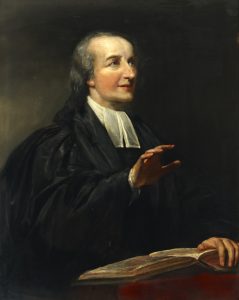
Here’s a question that often comes up: Where do John Wesley and his early followers fit in the familiar end-time schemas of a-millennial, post-millennial and pre-millennial (and it’s pre-trib, mid-trib, post-trib flavors)?
People looking for information about this find that there is very little available. Here’s the reason: John Wesley doesn’t fit any of these schemas exactly. He has been claimed by both pre-millennialists (Christ returns to establish an age of peace and righteousness on earth) and post-millennialists (an age of peace and righteousness on Earth is established through the advancement of Christian faith, and then Christ returns). And, individual quotations from his works can be lifted out both to support or refute both viewpoints.
First, let me note Wesley’s approach to the book of Revelation, as a way of introducing and illustrating the problem.
Hello Mr. Adams, I read with interest your comments on Calvin's comments on John 3:16 on your web site. I was wondering what your thoughts are on Jesus' words as recorded in John 6:44: “No one can come to Me unless the Father who sent Me draws him; and I will raise him up at the last day.” (NKJV) (It is unfortunate that English editions tend to translate the Greek as "draws" rather than the more accurate "compels" — especially since it is also translated more accurately as "dragged" elsewhere.) Have you considered that perhaps Calvin's "on the other hand" was intended to recognize what the whole of scripture says about this issue? He just may have been appealing to theology that is rooted in scripture itself.
In the first place, I would like to point out that my correspondent is attempting to play one Scripture off another. So, we are playing dueling Scripture passages here. Since the meaning of John 6:44 seems closely tied to its context, using it to fend off the idea of God’s universal love in John 3:16 (which seems to me to have a more general meaning) is a bad idea.
The context here has to do with the relationship of the Father and the Son. Jesus is claiming that the Jews are rejecting him because (in actuality) they have rejected the Father.
So, the context of this passage is not a discussion of whether God has chosen to send the mass of humanity to an eternal Hell, while choosing to arbitrarily save (by compulsion: “dragged”) a few. The context concerns why these particular Jews have not been drawn to Jesus as Messiah and Son, while others have. And, Jesus asserts here that it is because they have first rejected the Father and the testimony of the Scriptures.
Jesus denounces their claim to knowledge of the Father. He asserts that their resistance to the Father & the message of the Scriptures is the reason they have not subsequently been drawn to the Son. The point is made repeatedly. “And the Father who sent me has himself testified on my behalf. You have never heard his voice or seen his form…” (John 5:37). “You search the scriptures because you think that in them you have eternal life; and it is they that testify on my behalf.” (John 5:39). “How can you believe when you accept glory from one another and do not seek the glory that comes from the one who alone is God?” (John 5:44). “If you believed Moses, you would believe me, for he wrote about me. But if you do not believe what he wrote, how will you believe what I say?” (John 5:46, 47). And, earlier in chapter 5 it is stated the other way around: “Anyone who does not honor the Son does not honor the Father who sent him.” (John 5:23).
Thus the point is that the Jews who are rejecting him are doing so because they have first rejected the Father. But, Jesus asserts that those who acknowledged the Father were “drawn along” into acknowledging the Son.
My correspondent is right in saying that ἕλκω can mean “dragged.” It is a stronger word than is evident in our translations. In John 21:6 & 11 it is used of the drawing of fish in a net, in John 18:10 of the drawing of a sword, in Acts 16:19 & 21:30 of forcibly dragging the apostles through the streets, and in James 2:6 of being dragged into court.
But, the context tells us what Jesus means. Those who acknowledge the Father and the testimony of the Scriptures are compelled to also acknowledge the Son. However, the same word (ἕλκω) is also used in John 12:34 where Jesus says : “And I, when I am lifted up from the earth, will draw all people to myself.” (NRSV) If ἕλκω always means “forcibly dragged” then this passage would have to mean that all people (πάντας) are saved — universalism — something Calvinists do not generally affirm. Yet, in Matthew 23:37 (parallel in Luke 13:34) Jesus says: “O Jerusalem, Jerusalem, you who kill the prophets and stone those sent to you, how often I have longed to gather your children together, as a hen gathers her chicks under her wings, but you were not willing.” Thus, it appears, that Christ desires to draw to Himself people who are nonetheless unwilling to come! And, they do not. It is not that God chooses to arbitrarily save a few by divine compulsion. Though the Cross of Christ, He draws all. But, all do not come.
John Fletcher (1729-1785)
And, here, I think is where we get to the crux of the matter. The Bible continually assumes human moral responsibility. These Jews were responsible for their rejection of the Father and their rejection of the testimony of the Scriptures. It is everywhere assumed that a choice can be made, and that people can be held responsible for their choices.
The early Methodists objected to Calvinism on practical grounds, and not simply on theoretical grounds. Fletcher opposed what he called “Solafideism” because it was antinomian (“against the Law of God”): it undermined human moral responsibility through an appeal to God’s unconditional election to salvation.
Clearly, if you are saved, and you can’t be un-saved, and it is solely God’s choice — then it doesn’t matter what you do. Nothing is riding on it. While classical Calvinists never drew this conclusion, some people were willing to follow the logic of Calvinism to this inevitable conclusion. And, this is one of the things Arminians and Wesleyans and Methodists have always found objectionable: allowing an appeal to grace to undermine our responsibility to respond to God. A call to repentance, for example assumes the ability to respond. And, so forth.
In many, many ways the Bible continually assumes both the capacity to respond and the responsibility to respond. And, to my correspondent’s question “Have you considered that perhaps Calvin’s ‘on the other hand’ was intended to recognize what the whole of scripture says about this issue?” I have to give a terse: “No.” And, a too-quick harmonization of one Scripture with principles a person thinks they have derived from another is always dangerous. What do we mean by a “theology that is rooted in scripture itself”?
John Calvin (1509-1564)
I think Calvin came to his theological views, to a large extent, by way of Augustine. Certainly Augustine also appealed to Scripture for support of his views (though he was no Bible scholar), but his views were also shaped by the controversies of his day and the personal issues they raised for him.
None of us comes to the Scriptures in a vacuum. The notion that one simply shakes out all of the Bible’s teachings on the floor and arranges them systematically like a jigsaw puzzle is a mistake.
All of us have been influenced by preachers and Bible teachers. And, I wouldn’t say that is a bad thing — far from it. It’s a good thing. Not everything Augustine or Calvin said is wrong. I agree with much of what they said. They both can be read (critically) to great benefit. But, I also believe some legitimate objections can and should be raised against much of what they said.
Look folks: not everything Wesley or Fletcher or Clarke or their followers said is right, either. Nevertheless, if we read critically we can benefit from the insights of all.
Recently I posted: John Wesley and Spiritual Gifts. There I attempted to show that while Wesley was open to both extraordinary spiritual gifts and miracles, he did not insist on them as proof of the Holy Spirit’s presence.
Now let me say something about the distinctive pentecostal and charismatic teaching about Baptism with the Holy Spirit. There is a relationship between early Methodist teachings and the later development of Pentecostal teachings. In fact, a direct line can be traced from the teaching of the early Methodists to the teaching of the early Pentecostals.
Wesley’s preaching about the Christian life — and what he called Christian Perfection — gave rise to the holiness movement. The holiness movement, in turn, provided the seedbed from which the early Pentecostal movement would arise. Once people’s thinking about Christian experience begins to go down a particular road, certain directions become inevitable.
What would have been John Wesley’s attitude toward the modern doctrine and practice of Speaking in Tongues? Pentecostal churches teach that this is a necessary initial sign of the Baptism of the Holy Spirit (a empowerment experience subsequent to Christian conversion). Other churches teach that spiritual gifts and miracles were signs that ceased after the age of the apostles. Where would Wesley have stood on these issues?
The evangelistic ministry and teaching John Wesley provided the impetus for the development of the Methodist & Holiness movements. The holiness movement, in turn, provided the seedbed for the emergence of early Pentecostalism. The original Azusa Street Pentecostalism in turn provided the impetus for the development of the modern Pentecostal & Charismatic movements — which have (somewhat ironically) often lost or even explicitly denied the Holiness / Sanctification themes in Wesley’s teachings.
That is a rather complicated schema. Is there any evidence of this later unfolding that is already present in Wesley teachings? Wesley distinguished between “extraordinary gifts” and “ordinary” graces of the Spirit. Speaking in Tongues would fall into the category of “extraordinary gifts.” Thus, he did not see the gift of Tongues as part of the abiding significance of the Pentecost event.
The original Methodist revival was a movement intended to produce “real Christians,” that is, Christians who would actually live out the faith they professed. In my opinion: we are in desperate need of such a thing today.
In the Methodist revival, the means used to achieve this goal were:
a message of experienced religion & holiness which drew heavily from the Bible,
large praise and preaching gatherings (the Societies),
small accountability groups (the classes, bands & select societies),
works of service and mercy (generally: addressing the needs of the poor or imprisoned).
This was not intended to produce “Church Growth” or some such thing, it was intended to produce Christians who visibly and noticeably loved God with all their heart, mind, soul and strength and their neighbors as themselves. What can be learned by this evangelistic & discipleship strategy for our day?
Only beware thou do not deceive thy own soul with regard to the nature of this faith. It is not, as some have fondly conceived, a bare assent to the truth of the Bible, of the articles of our creed, or of all that is contained in the Old and New Testament. The devils believe this, as well as I or thou! And yet they are devils still. But it is, over and above this, a sure trust in the mercy of God, through Christ Jesus. It is a confidence in a pardoning God. It is a divine evidence or conviction that ‘God was in Christ, reconciling the world to himself, not imputing to them their’ former ‘trespasses;’ and, in particular, that the Son of God hath loved me, and given himself for me; and that I, even I, am now reconciled to God by the blood of the cross.
These reflections from New Testament scholar C. H. Dodd seem to me to be close to the heart of Wesleyan theology. He is reflecting here on the significance of the apostle Paul’s theology of the Christian life. Paul teaches that we are justified — set right with God — by faith. But, as with justification, what we often call “sanctification” (conformity to the image of Christ) is also by grace through faith.
C. H. Dodd (1884-1973)
The higher faiths call their followers to strenuous moral effort. Such effort is likely to be arduous and painful in proportion to the height of the ideal, desperate in proportion to the sensitiveness of the conscience. A morbid scrupulousness besets the morally serious soul. It is anxious and troubled, afraid of evil, haunted by the memory of failure. The best of the Pharisees tended in this direction, and no less the best of the Stoics. And so little has Christianity been understood that the popular idea of a serious Christian is modeled upon the same type of character. The ascetic believed that, because he was so holy, the Devil was permitted special liberties with him, and he found in his increasing agony of effort a token of divine approval. Not along this track lies the path of moral progress. Christianity says: face the evil once for all, and disown it. Then quiet the spirit in the presence of God. Let His perfections fill the field of vision. In particular, let the concrete embodiment of the goodness of God in Christ attract and absorb the gaze of the soul. Here is the righteousness, not as a fixed and abstract ideal, but in a living human person. The righteousness of Christ is a real achievement of God’s own Spirit in man.
I just re-blogged this quote from the Religious Maxims of Thomas C. Upham over at the Hidden Life blog:
It seems to have been the doctrine of some advocates of Christian perfection, especially some pious Catholics of former times, that the various propensities and affections, and particularly the bodily appetites, ought to be entirely eradicated. But this doctrine, when carried to its full extent, is one of the artifices of Satan, by which the cause of holiness has been greatly injured. It is more difficult to regulate the natural principles, than to destroy them; and there is no doubt that the more difficult duty in this case, is the scriptural one. We are not required to eradicate our natural propensities and affections, but to purify them. We are not required to cease to be men, but merely to become holy men.
— Religious Maxims (1846) XXXIV.
This is the kind of thing I was surprised to discover when I began reading the old holiness writings. Why do I say “surprised”?
Another ground of these, and a thousand mistakes, is, the not considering deeply, that love is the highest gift of God; humble, gentle, patient love; that all visions, revelations, manifestations whatever, are little things compared to love; and that all the gifts above-mentioned are either the same with, or infinitely inferior to, it. It were well you should be thoroughly sensible of this, —’the heaven of heavens is love.’ There is nothing higher in religion; there is, in effect, nothing else; if you look for anything but more love, you are looking wide of the mark, you are getting out of the royal way. And when you are asking others, ‘Have you received this or that blessing?’ if you mean anything but more love, you mean wrong; you are leading them out of the way, and putting them upon a false scent. Settle it then in your heart, that from the moment God has saved you from all sin, you are to aim at nothing more, but more of that love described in the thirteenth of the Corinthians. You can go no higher than this, till you are carried into Abraham’s bosom.
First, I need to explain this: when I say “Methodist” I don’t mean it in any denominational sense at all. Yes, I served for many years as a pastor in the United Methodist Church. And, at that time I was quite loyal. I came to Christ long ago at a holiness camp-meeting. But, I really don’t mean to speak of this in any sectarian sense at all.
For many, the often over-stated claims of the Holiness movement are an embarrassment. Yet, I find these writings a helpful corrective to the casual “Christians Aren’t Perfect They’re Just Forgiven” attitude of so much of contemporary Christian culture. It’s a helpful corrective to a church that has come to peaceful terms with the injustices of this world — rather than challenging and correcting them.
I am glad I came to Christ in the context of a group of people who believed that faith in Christ made a real difference in a person’s life. I am thankful for a message — however difficult — that challenged me to fully open my life to the power of God’s Spirit. I am glad I heard a Gospel that still held to a message, not only of forgiveness, but also of change and new life. John Wesley’s writings and the commentaries of Adam Clarke were formative influences on me in the development of my faith — and my understanding of the meaning and relevance of the Bible’s teachings. Every once in a while I run across something that reminds me why I’m glad I used to read this material — and the value I have always found in it.
The Gospel as preached by Wesley and those who imitate him, appeals with peculiar force to the intelligent common-sense of all unconverted men. All such men feel that under the circumstances and conditions of human life, it was incumbent upon God to make salvation possible to every soul.
It has been the mission of Methodism to destroy the unreasonable and illogical and unscriptural dogmas of Calvinistic fatalism, and show how God could be just and yet the justifier of every believing soul that in real penitence accepts the Lord Jesus Christ; and, also, how God can save all infants and irresponsible persons, and how in every nation all who fear God and work righteousness, though they have never heard the Gospel, are accepted by Him.
These fundamental truths as set forth by John Wesley, have never failed to commend themselves to the favorable consideration of all unprejudiced minds, for they at once glorify the Divine justice and compassion, and throw wide open the door of hope to every soul.
But Wesley was thorough and exhaustive in his treatment of whatever was the subject of his investigations. For many long and weary years he groped in the thick darkness of the times in which he lived, seeking for the simplest experience of salvation. He abounded in all manner of self-denials and self-sacrifices; his morality was [of] the most exalted character; he was diligent in prayer and in the study of God’s word; he was most strict in all the outward forms and services of religion; but until he reached his thirty-fifth year he had not attained the consciousness of pardon in his own soul; he could not testify that God for Christ’s sake had forgiven him his sins.
From that auspicious and ever-memorable, as well as glorious hour, when, listening to the reading of Luther’s Preface to the Epistle to the Romans, he felt his heart strangely warmed with the love of God, and knew himself to be a pardoned sinner, he went straight forward as the Spirit of God directed his steps, till he came to the experience of perfect love in his own soul.
Notice the power of what Mallalieu says. He is expounding a point of view that has become largely forgotten. Salvation is available to all — it is not withheld from any. Determinism is denied. Atonement is available for all who will have it. God is fair and will judge all people fairly — taking consideration for the knowledge that had in this life. Emphasis is placed on the experience of forgiveness and the witness of the Spirit. The life of the Spirit is held up as a life of love: devoted to God’s will and to the best interests of all people. The goal of the spiritual life is taught as being perfected love. And, people so changed by the Spirit of God, also believe that their world can be changed for the better: it can become a more fair and humane place.
A new generation of Christians need to arise who will challenge the assumptions under which today’s church operates. Someone needs to challenge the notion that there is no genuine cure for sin. Someone needs to challenge the idea that the world must always go from bad to worse until Jesus returns.
If, though the life, death and resurrection of Christ God’s Kingdom has come in the here-and-now then there is hope for people and there is hope for the world. It is time to recover this Wesleyan optimism of grace!
I don’t really care if people call it “Wesleyan Theology”either. I don’t care if people use the term “Methodist” or decide to discard it. That is not the point. In fact, John Wesley isn’t the point. It’s the gospel to which he pointed: the message of hope in Jesus Christ.
This can still change people. Yes, and it can change the world.