“To you, O Lord, I lift up my soul. O my God, in you I trust; do not let me be put to shame; do not let my enemies exult over me. Do not let those who wait for you be put to shame; let them be ashamed who are wantonly treacherous.” (Psalms 25:1-3 NRSV)
Several years ago, I began thinking of Psalm 25 as a Psalm for the waiting times.
There are lots of Psalms — and other passages of Scripture — like this, but I hadn’t always seen Psalm 25 this way. Here is what I mean. Many times in the Hebrew scriptures we are exhorted to “wait on the LORD” — and we are told the advantages of such an approach to life. “Wait for the Lord; be strong, and let your heart take courage; wait for the Lord!” (Psalms 27:14 NRSV) “For the wicked shall be cut off, but those who wait for the Lord shall inherit the land.” (Psalms 37:9 NRSV) “I wait for the Lord, my soul waits, and in his word I hope….” (Psalms 130:5 NRSV).
Here’s a question that often comes up: Where do John Wesley and his early followers fit in the familiar end-time schemas of a-millennial, post-millennial and pre-millennial (and it’s pre-trib, mid-trib, post-trib flavors)?
People looking for information about this find that there is very little available. Here’s the reason: John Wesley doesn’t fit any of these schemas exactly. He has been claimed by both pre-millennialists (Christ returns to establish an age of peace and righteousness on earth) and post-millennialists (an age of peace and righteousness on Earth is established through the advancement of Christian faith, and then Christ returns). And, individual quotations from his works can be lifted out both to support or refute both viewpoints.
First, let me note Wesley’s approach to the book of Revelation, as a way of introducing and illustrating the problem.
“He will send from heaven and save me, he will put to shame those who trample on me [Selah] God will send forth his steadfast love and his faithfulness.” (NRSV)
God’s deliverance is signified here by these two words:
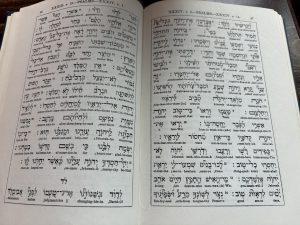
steadfast love חָסַד
faithfulness אֱמֶת
And, what can be said? There is a great depth of meaning here. These words are deep and beautiful because of the meaning they gain through their frequent use in the Scriptures. The nature of God’s deliverance may not be known in detail. It never is. But, we know how God acts. We know something of God’s character. “God will send forth his steadfast love and his faithfulness.” That’s all we need to know.
Hello Mr. Adams, I read with interest your comments on Calvin's comments on John 3:16 on your web site. I was wondering what your thoughts are on Jesus' words as recorded in John 6:44: “No one can come to Me unless the Father who sent Me draws him; and I will raise him up at the last day.” (NKJV) (It is unfortunate that English editions tend to translate the Greek as "draws" rather than the more accurate "compels" — especially since it is also translated more accurately as "dragged" elsewhere.) Have you considered that perhaps Calvin's "on the other hand" was intended to recognize what the whole of scripture says about this issue? He just may have been appealing to theology that is rooted in scripture itself.
In the first place, I would like to point out that my correspondent is attempting to play one Scripture off another. So, we are playing dueling Scripture passages here. Since the meaning of John 6:44 seems closely tied to its context, using it to fend off the idea of God’s universal love in John 3:16 (which seems to me to have a more general meaning) is a bad idea.
The context here has to do with the relationship of the Father and the Son. Jesus is claiming that the Jews are rejecting him because (in actuality) they have rejected the Father.
So, the context of this passage is not a discussion of whether God has chosen to send the mass of humanity to an eternal Hell, while choosing to arbitrarily save (by compulsion: “dragged”) a few. The context concerns why these particular Jews have not been drawn to Jesus as Messiah and Son, while others have. And, Jesus asserts here that it is because they have first rejected the Father and the testimony of the Scriptures.
Jesus denounces their claim to knowledge of the Father. He asserts that their resistance to the Father & the message of the Scriptures is the reason they have not subsequently been drawn to the Son. The point is made repeatedly. “And the Father who sent me has himself testified on my behalf. You have never heard his voice or seen his form…” (John 5:37). “You search the scriptures because you think that in them you have eternal life; and it is they that testify on my behalf.” (John 5:39). “How can you believe when you accept glory from one another and do not seek the glory that comes from the one who alone is God?” (John 5:44). “If you believed Moses, you would believe me, for he wrote about me. But if you do not believe what he wrote, how will you believe what I say?” (John 5:46, 47). And, earlier in chapter 5 it is stated the other way around: “Anyone who does not honor the Son does not honor the Father who sent him.” (John 5:23).
Thus the point is that the Jews who are rejecting him are doing so because they have first rejected the Father. But, Jesus asserts that those who acknowledged the Father were “drawn along” into acknowledging the Son.
My correspondent is right in saying that ἕλκω can mean “dragged.” It is a stronger word than is evident in our translations. In John 21:6 & 11 it is used of the drawing of fish in a net, in John 18:10 of the drawing of a sword, in Acts 16:19 & 21:30 of forcibly dragging the apostles through the streets, and in James 2:6 of being dragged into court.
But, the context tells us what Jesus means. Those who acknowledge the Father and the testimony of the Scriptures are compelled to also acknowledge the Son. However, the same word (ἕλκω) is also used in John 12:34 where Jesus says : “And I, when I am lifted up from the earth, will draw all people to myself.” (NRSV) If ἕλκω always means “forcibly dragged” then this passage would have to mean that all people (πάντας) are saved — universalism — something Calvinists do not generally affirm. Yet, in Matthew 23:37 (parallel in Luke 13:34) Jesus says: “O Jerusalem, Jerusalem, you who kill the prophets and stone those sent to you, how often I have longed to gather your children together, as a hen gathers her chicks under her wings, but you were not willing.” Thus, it appears, that Christ desires to draw to Himself people who are nonetheless unwilling to come! And, they do not. It is not that God chooses to arbitrarily save a few by divine compulsion. Though the Cross of Christ, He draws all. But, all do not come.
John Fletcher (1729-1785)
And, here, I think is where we get to the crux of the matter. The Bible continually assumes human moral responsibility. These Jews were responsible for their rejection of the Father and their rejection of the testimony of the Scriptures. It is everywhere assumed that a choice can be made, and that people can be held responsible for their choices.
The early Methodists objected to Calvinism on practical grounds, and not simply on theoretical grounds. Fletcher opposed what he called “Solafideism” because it was antinomian (“against the Law of God”): it undermined human moral responsibility through an appeal to God’s unconditional election to salvation.
Clearly, if you are saved, and you can’t be un-saved, and it is solely God’s choice — then it doesn’t matter what you do. Nothing is riding on it. While classical Calvinists never drew this conclusion, some people were willing to follow the logic of Calvinism to this inevitable conclusion. And, this is one of the things Arminians and Wesleyans and Methodists have always found objectionable: allowing an appeal to grace to undermine our responsibility to respond to God. A call to repentance, for example assumes the ability to respond. And, so forth.
In many, many ways the Bible continually assumes both the capacity to respond and the responsibility to respond. And, to my correspondent’s question “Have you considered that perhaps Calvin’s ‘on the other hand’ was intended to recognize what the whole of scripture says about this issue?” I have to give a terse: “No.” And, a too-quick harmonization of one Scripture with principles a person thinks they have derived from another is always dangerous. What do we mean by a “theology that is rooted in scripture itself”?
John Calvin (1509-1564)
I think Calvin came to his theological views, to a large extent, by way of Augustine. Certainly Augustine also appealed to Scripture for support of his views (though he was no Bible scholar), but his views were also shaped by the controversies of his day and the personal issues they raised for him.
None of us comes to the Scriptures in a vacuum. The notion that one simply shakes out all of the Bible’s teachings on the floor and arranges them systematically like a jigsaw puzzle is a mistake.
All of us have been influenced by preachers and Bible teachers. And, I wouldn’t say that is a bad thing — far from it. It’s a good thing. Not everything Augustine or Calvin said is wrong. I agree with much of what they said. They both can be read (critically) to great benefit. But, I also believe some legitimate objections can and should be raised against much of what they said.
Look folks: not everything Wesley or Fletcher or Clarke or their followers said is right, either. Nevertheless, if we read critically we can benefit from the insights of all.
The themes in this section of the Gospel of John resonate well with the themes I am often addressing at this web site. Jesus calls his followers into a life of obedience — and promises the power and presence of the Holy Spirit to them.
In the Gospel of John, we see Jesus preparing his disciples for the days to come with a long discourse: it begins in Chapters 13 and runs through chapter 16, with a closing prayer added in chapter 17. The passage I’m discussing today is just a brief snippet from that longer discourse. This passage is memorable because in contains of the promise of the Holy Spirit. But, it is framed on either side by a challenge to keep Christ’s commandments.
“He will send from heaven and save me, he will put to shame those who trample on me. Selah. God will send forth his steadfast love and his faithfulness.” (NRSV.)
The next phrase (“he will put to shame those who trample on me”) points up one of my long-standing problems with the Psalms. When I first began to read the Psalms, as a young man, I was put off by the recurrent theme of “enemies.” Praying to God in the midst of confusion and need I could understand. Praying to God in times of distress and suffering I could understand. But, the frequent and recurrent theme of persecution by enemies was something with which I could not connect. Or, maybe I just didn’t want to connect with it.
“He will send from heaven and save me, he will put to shame those who trample on me. Selah. God will send forth his steadfast love and his faithfulness.” Psalm 57:3 (Hebrew: verse 4) (NRSV)
My first reading of this is: “God will send help from far away.” And, there is some basis for this reading. But, that’s not the whole story.
“For God so loved the world that he gave his only Son, so that everyone who believes in him may not perish but may have eternal life.” — John 3:16 (NRSV).
JOHN CALVIN COMMENTS (my responses have a white background):
John Calvin (1509-1564)
“’That whosoever believeth on him may not perish.’ It is a remarkable commendation of faith, that it frees us from everlasting destruction. For he intended expressly to state that, though we appear to have been born to death, undoubted deliverance is offered to us by the faith of Christ; and, therefore, that we ought not to fear death, which otherwise hangs over us. And he has employed the universal term whosoever, both to invite all indiscriminately to partake of life, and to cut off every excuse from unbelievers. Such is also the import of the term world, which he formerly used; for though nothing will be found in the world that is worthy of the favor of God, yet he shows himself to be reconciled to the whole world, when he invites all men without exception to the faith of Christ, which is nothing else than an entrance into life.”
Um. Okay. I think I’m with you there, brother John.
“Let us remember, on the other hand, that while life is promised universally to all who believe in Christ, still faith is not common to all. For Christ is made known and held out to the view of all, but the elect alone are they whose eyes God opens, that they may seek him by faith. Here, too, is displayed a wonderful effect of faith; for by it we receive Christ such as he is given to us by the Father — that is, as having freed us from the condemnation of eternal death, and made us heirs of eternal life, because, by the sacrifice of his death, he has atoned for our sins, that nothing may prevent God from acknowledging us as his sons. Since, therefore, faith embraces Christ, with the efficacy of his death and the fruit of his resurrection, we need not wonder if by it we obtain likewise the life of Christ.”
Whoa! What do you mean “on the other hand”? Umm… Now you seem to be dodging out of it all by appealing to a theology that is rooted in something else, John. Here you are clearly leaving exegesis behind and trying to reconcile the verse with a preconceived theology. How can ‘life’ be promised to those incapable of receiving it? It can’t. How can God ‘invite all indiscriminately to partake of life, and to cut off every excuse from unbelievers’ (as you say) if God is choosing to withhold the ability to believe from some? You can’t have it both ways. I mean, I know you’re a logical guy, John. Isn’t it possible that Augustine was wrong in the Enchiridion — where this same logical inconsistency can be found?
“Still it is not yet very evident why and how faith bestows life upon us. Is it because Christ renews us by his Spirit, that the righteousness of God may live and be vigorous in us; or is it because, having been cleansed by his blood, we are accounted righteous before God by a free pardon? It is indeed certain, that these two things are always joined together; but as the certainty of salvation is the subject now in hand, we ought chiefly to hold by this reason, that we live, because God loves us freely by not imputing to us our sins. For this reason sacrifice is expressly mentioned, by which, together with sins, the curse and death are destroyed. I have already explained the object of these two clauses, which is, to inform us that in Christ we regain the possession of life, of which we are destitute in ourselves; for in this wretched condition of mankind, redemption, in the order of time, goes before salvation.”
What! Now you seem to be having problems with your earlier statement that [faith] ‘frees us from everlasting destruction.’ Do you mean: ‘faith bestows life upon us’ (as you said earlier) or: ‘life’ (through grace) bestows faith upon us? Now you are saying that redemption precedes salvation, because the ability to believe is itself the result of that salvation. If the ability to believe is wholly the decision of God, then it is God who has determined the issues of life and death. It is your theology that has dictated that: “redemption, in the order of time, goes before salvation” — not the text itself. I agree that part of the message of this verse is ‘that in Christ we regain the possession of life, of which we are destitute in ourselves’ but it is also a universal offer of eternal life (thus, it says: “whoever”) — a possibility your theology does not seem to allow for! In my opinion, making sense of this verse requires a concept of Prevenient Grace, which allows fallen humans to respond with faith to the offer of life. Otherwise, from your point of view, the verse should read either:
“For God so loved the elect that he gave his only Son, so that everyone who belongs to the elect and, thus, has faith, may therefore believe in him unto eternal life.”
or more simply:
“For God so loved the world that he gave his only Son, so that everyone who has eternal life may believe in him.”
But, surely you see, don’t you, it doesn’t say either of those things. You’ve turned it around backwards. This is no longer the Scripture with which you began.
(Start gathering the wood again, boys, I think there’s another heretic in town.)
QUESTION: Where is the Pre-Tribulational Rapture of the Church taught in the Bible.
ANSWER: It is not taught in the Bible. It is the implication of a theory of interpretation of the Bible known as Dispensationalism.
I’m old enough to remember the Larry Norman song “I Wish We’d All Been Ready” (used extensively in evangelism). It was part of a a fear-evangelism tactic used to scare people (especially young people) into accepting Jesus as Savior before it was too late. Here are some of the lyrics:
A man and wife asleep in bed She hears a noise and turns her head he’s gone I wish wed all been ready Two men walking up a hill One disappears and ones left standing still I wish wed all been ready
[Chorus] There’s no time to change your mind The son has come and you’ve been left behind
Many years after all that, I also remember the brief furor that was caused by a booklet that gave 88 reasons why Jesus was returning in 1988. Then after that, Harold Camping predicted Jesus’ return on May 21, 2011. Over the years, many of the predictions of end-times prophecy teachers have failed — some quite spectacularly — but, this is quickly forgotten when a new round of predictions starts up again.
The doctrine of the Rapture has been a staple of American fear-evangelism for a long time. In this teaching, Jesus will return secretly to remove all true Christian believers from the world — then a time of horrible Tribulation will ensue. And, it is still commonly taught by certain well-known “prophetic” teachers.
Evangelical and conservative Christians pride themselves on their devotion to the Bible. Yet, there are certain common features of conservative Christian teaching about the return of Christ which have little or no backing from the Scriptures. Specifically, the teaching that Christ will come silently and secretly to take believers out of the world, seven years before he returns in glory, is a teaching the lacks Biblical support.
“I cry to God Most High, to God who fulfills his purpose for me.” (NRSV)
As I said last time: this expresses the intention to pray. The initial cry for help, is followed by a statement of intent: a general statement telling us why the Psalmist cries out to God. It’s not just a momentary thing: it’s a way of life.
What I want to point out is the brevity of that final phrase: